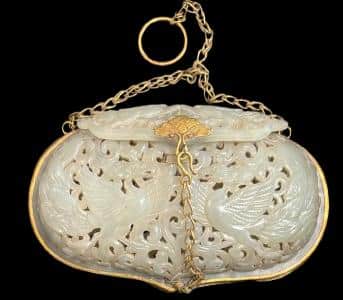
A PIERCED JADE POMANDER MOUNTED IN SILVER-GILT
An extraordinary pierced jade pomander originates from 11th-century Liao Dynasty China. This rare piece of ancient Asian art showcases the supreme craftsmanship and nomadic luxury traditions of Khitan nobility. Furthermore, Liao master lapidaries combined complex jade carving techniques with silver-gilt mounts to craft exquisite personal luxury items. Today, these ancient ornaments remain highly prized by collectors of museum-quality historic artifacts.
Design of the Pierced Jade Pomander
First, the pierced jade pomander centers around a pair of confronted phoenixes (fenghuang) carved in openwork. The noble birds display intricately detailed wings and flowing tails amidst swirling floral scrolls. Encasing the carved jade body is a fine silver-gilt frame that seals the purse-like form. In addition, an elaborate lotus-shaped clasp secures the central chain, which extends into delicate suspension links and a top mounting ring designed for wearing on a silk belt.
Most importantly, the defining characteristic of this piece relies on its delicate openwork jade carving combined with silver-gilt metalwork. Khitan artisans selected a high-grade celadon-white nephrite jade with remarkable translucency and soft polish. As a result, this openwork arrangement allowed aromatic materials or scented herbs to diffuse naturally. Consequently, combining openwork nephrite jade with gilded silver fittings remains a defining hallmark of imperial Liao luxury culture.
| Place of origin | China |
| Date | Liao Dynasty (11th Century) |
| Availability | US$ |
| Reference number | SO-000152 |